Type something to search...
Optical Vortex Phase Masks for the Detection of Habitable Worlds  - NASA Science

Optical Vortex Phase Masks for the Detection of Habitable Worlds  - NASA Science

A team of NASA researchers is developing new types of optical masks that could help enable the many orders of magnitude of starlight suppression needed for future space observatories to pick out very faint habitable exoplanets from the far brighter glare of their stellar hosts. 
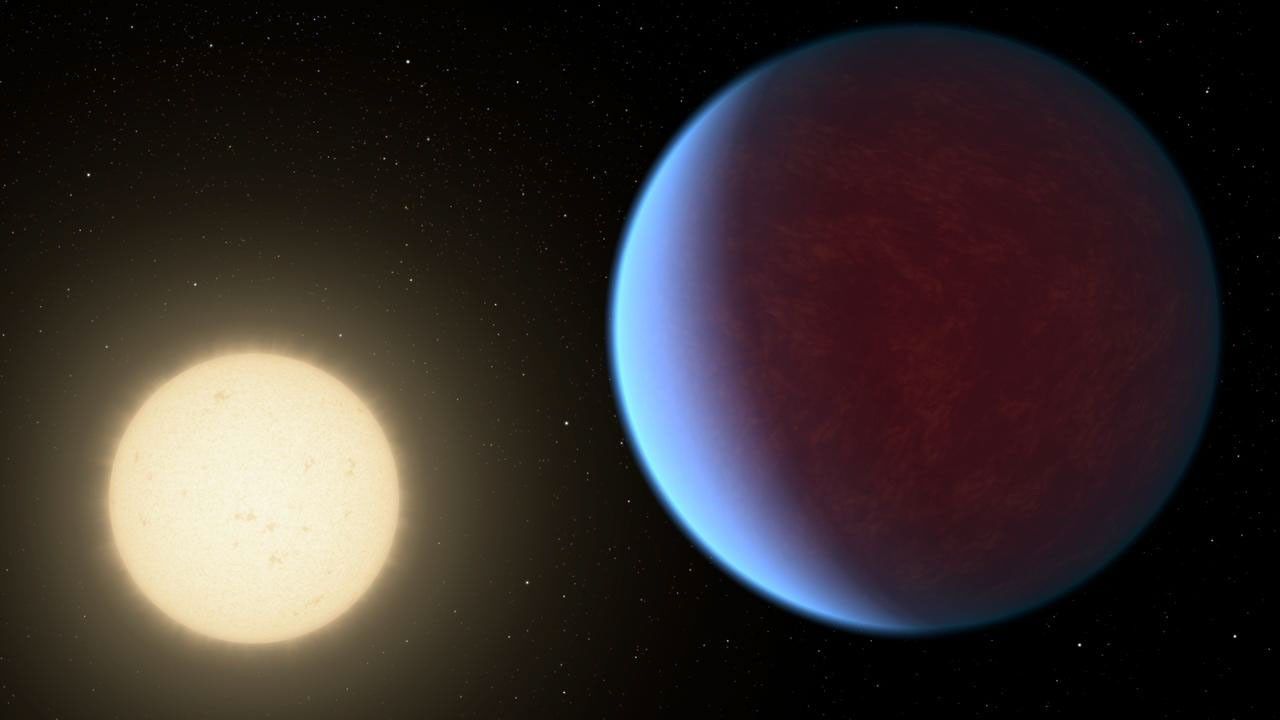
Artist's conception of an exoplanet reflecting the light from its nearby star.
NASA

One of the goals of NASA’s Astrophysics Division is to carry out a census of nearby solar systems to search for habitable worlds around nearby stars, and ultimately, to determine whether life might be present outside our own solar system. Because other stars are so far away, we must rely on remote observations of these systems, and in particular, on the spectroscopy of any planets present (i.e., on the examination of their color characteristics to determine their atmospheric characteristics). NASA’s future Habitable Worlds Observatory (HWO) mission will be the first telescope designed specifically to search for signs of life on planets orbiting other stars.  

Significant progress has been made over the past couple of decades in observing the brightest and often largest exoplanets, especially those that happen to pass in front of their stars, allowing us to see the planet’s atmospheric constituents that absorb particular colors of the host star’s light. However, most exoplanets are not so favorably aligned; to detect them, HWO must be able to distinguish the very small bit of light coming from an exoplanet from the overwhelming glare of the very bright nearby host star. For example, an Earth-like planet orbiting a star similar to our Sun would be only about 1 ten billionth as bright as its host star. An apt analogy is the light from a firefly flying right next to a lighthouse! 

To see faint potentially habitable worlds in nearby solar systems, we must remove the incoming starlight to such an extent that the much smaller bit of light arriving from the exoplanet can be distinguished. Unfortunately, telescopes don’t produce perfect point-like images of stars. Two contributing factors–scattering and diffraction—blur and spread the starlight across the region of the image where exoplanets are likely to be found.  

Scattering of starlight is caused by surface irregularities in the mirrors that make up the telescope’s optical system. These irregularities can be mitigated by using a high-performance adaptive optics system to correct the wavefront errors. But even with a perfectly corrected optical system, diffraction must also be mitigated.  

Diffraction is the angular spread of a light beam (or of any type of wave, including water or sound waves) that occurs as the wave passes through an aperture, such as a telescope’s light-collecting mirror. Diffraction causes the starlight to spread across the focal plane into a ringed light distribution called an Airy pattern (see figure below). Since this Airy pattern can be many times brighter than the light emitted from an exoplanet, it also needs to be removed.  
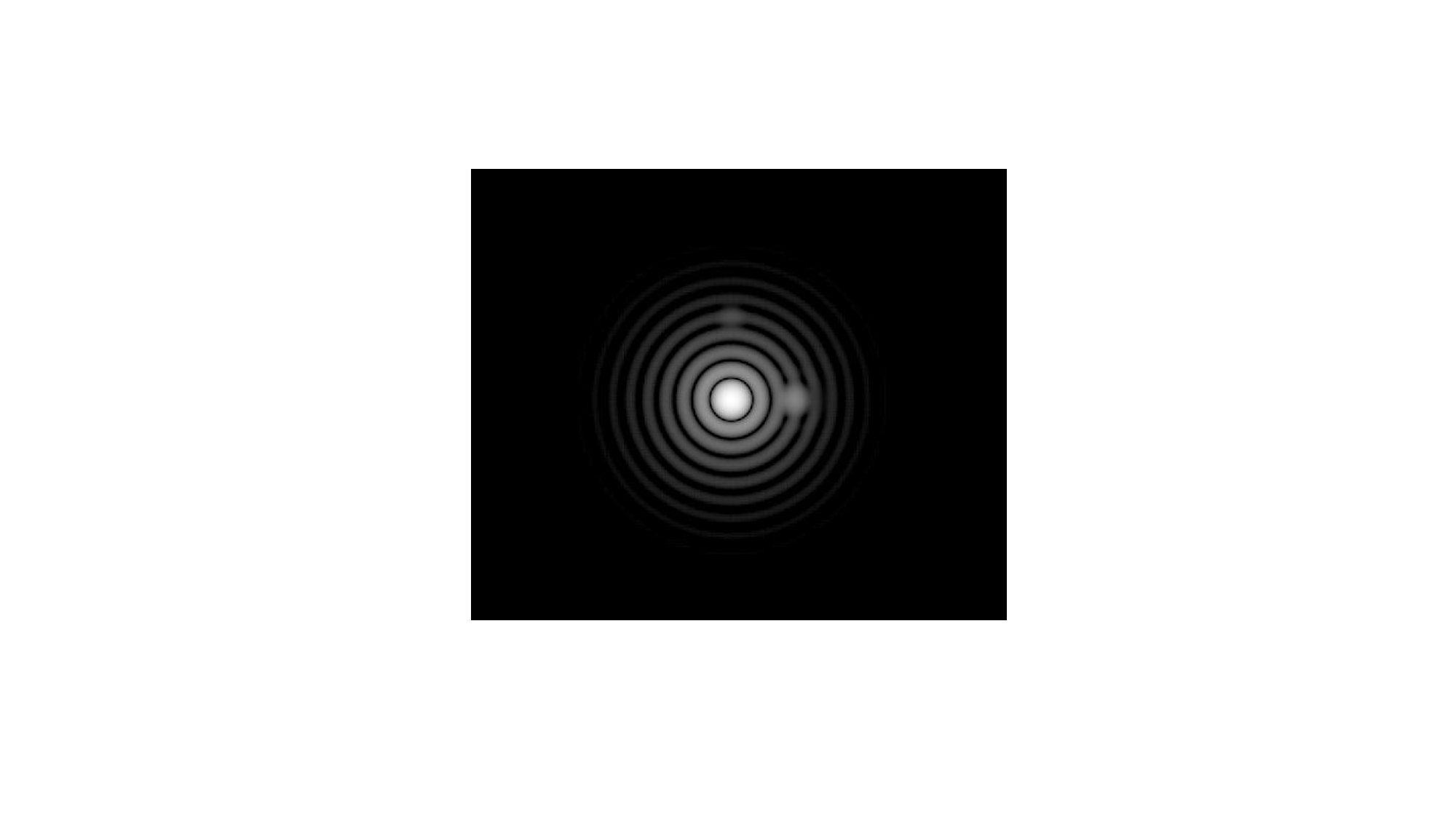
Concentric white circles on a black background, with two circles around the center at 12 o'clock and 3 o'clock
A logarithmically scaled simulation of the image of a star with two nearby exoplanets, as seen by a telescope with a circular aperture. The centered multi-ringed Airy pattern is due to diffraction of the starlight. Off-axis exoplanets fainter by 100 times and 1000 times are seen at 3 o’clock on the 3rd Airy ring, and at 12 o’clock on the 4th Airy ring, respectively. An Earth-like exoplanet would be 10 million times fainter than the dimmer of the two exoplanets shown.
Gene Serabyn, NASA JPL

Suppression of the Airy pattern’s rings is usually done with an optical instrument known as a coronagraph. The coronagraph was invented a century ago to allow astronomers to see the faint solar corona that surrounds the Sun. When applied to other stars, a coronagraph can enable us to see faint exoplanets near their much brighter stars.  

The core component of most coronagraphs is an optical mask—a small piece of glass with a special surface coating or surface shape that is designed to either selectively attenuate or delay the light distribution making up the stellar image. One particularly promising type of optical mask is the optical vortex phase mask, which applies a phase delay that increases in proportion to the azimuthal angle around the center of the mask (see figure below). When centered on the stellar Airy pattern, the mask thus applies delays that increase along the Airy rings. 
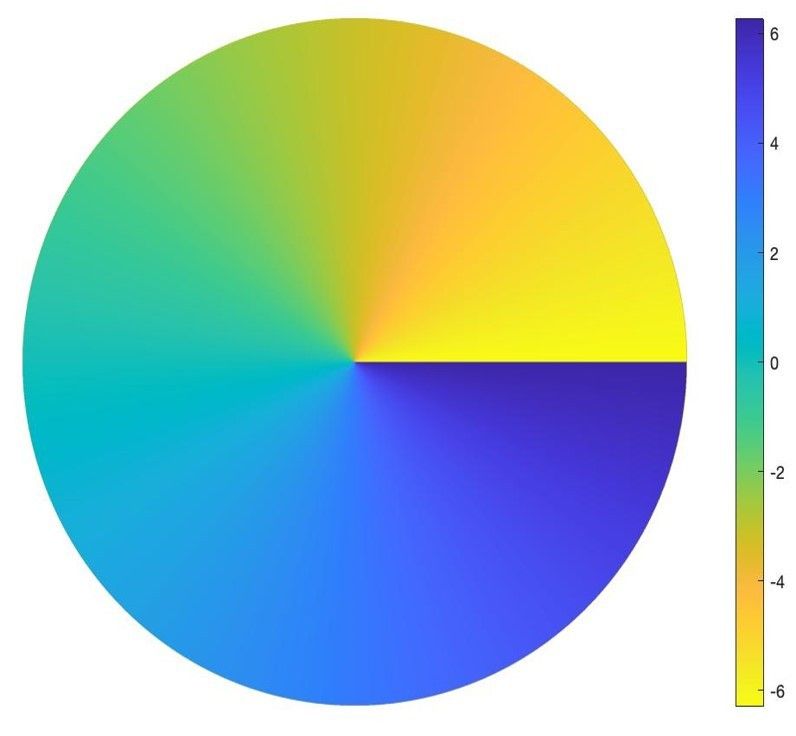
The colors in this image depict the phase delay pattern that a vortex phase mask applies to the incoming starlight in the focal plane: the phase delay increases azimuthally around the center of the mask. The colors indicate a phase delay range from -2 pi to 2 pi (-6.28 to 6.28) radians.
Gene Serabyn, NASA JPL

This delay pattern, which is somewhat analogous to the helical surface of a screw thread, causes the starlight to destructively interfere in such a way that if one reimages the telescope aperture downstream of the vortex mask, no starlight remains inside that aperture image. Instead, the starlight is only seen outside of where the filled telescope aperture image is expected to be, where it can then be easily blocked by a simple aperture stop, as is used in photography. (The figure below depicts images of a telescope aperture in advance of and downstream of the vortex mask.) Since the light from the exoplanet typically hits the vortex mask off-center, it propagates unchanged through the aperture stop to reach the detector, where it can be successfully imaged. 
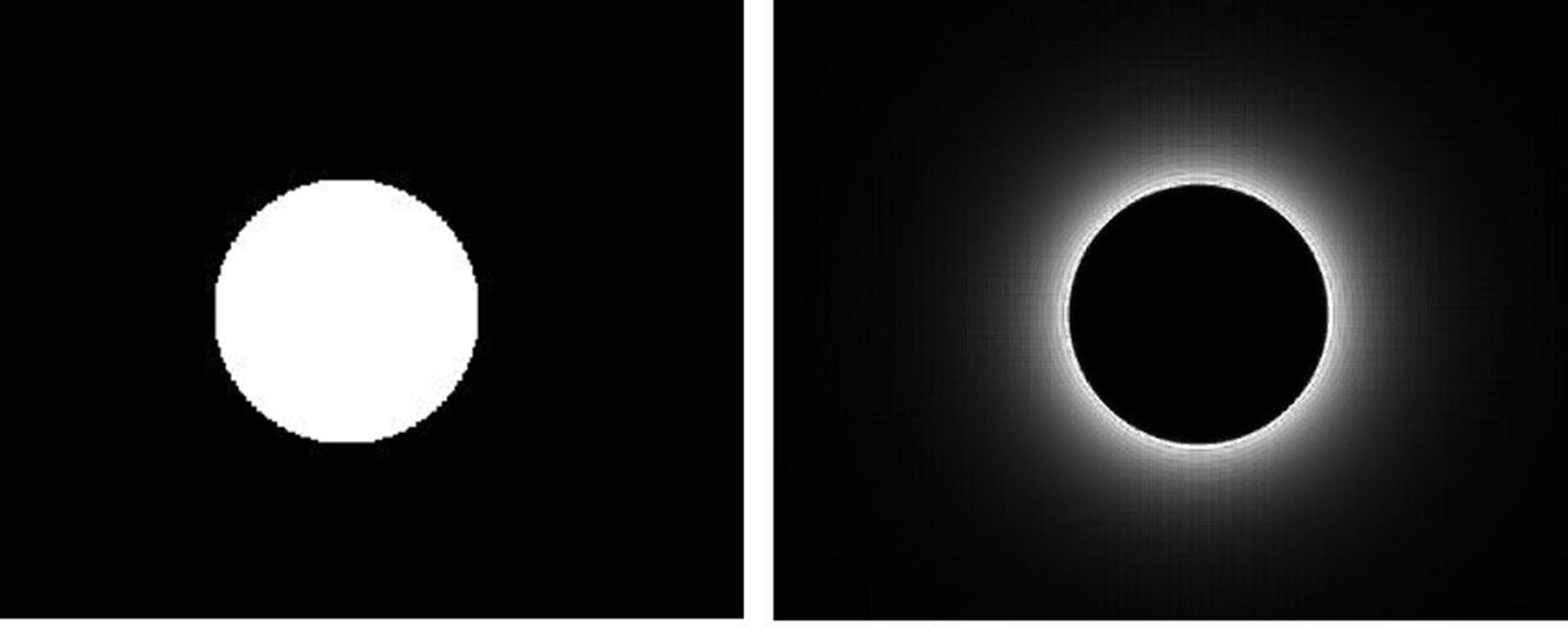
Side by side black rectangles, left one with solid white circle and right one with a black circle with white hazy outline reminiscent of a total eclipse
The left-hand panel shows a normal image of a telescope aperture that is filled with starlight. After passing through the vortex phase mask, the starlight is expelled from that circular region (as shown in the right-hand image) where it can be blocked by an aperture stop, leaving only exoplanet light inside the bright rim of starlight.
Gene Serabyn, NASA JPL

Fabricating vortex masks is challenging since they must be able to simultaneously reject starlight over a wide range of wavelengths. A team of technologists at the NASA Jet Propulsion Laboratory (JPL) is investigating a number of different technologies that could be used make optical vortex masks with the desired characteristics. To date, the most promising approach uses a flat layer of a specially prepared liquid crystal polymer (LCP) to provide the required optical delay pattern. The long molecular polymer chains making up the LCP layer can be specifically oriented to induce different delays in the two polarization directions of light. (Polarization refers to the direction of oscillation of the electric field vector in a propagating light wave, i.e., whether it is up-down or left-right). Depending on whether the electric field vector lies along or perpendicular to the long LCP axis, the light experiences different delays.  

Moreover, if the LCP layer is laid down in a pattern wherein the long LCP axis rotates while following a circular path around the mask’s center (reaching a multiple of a full molecular rotation in a full circuit around the center), the desired delay pattern can be achieved (see figure below).  The main advantage of such masks is that since their phase delays are induced geometrically (i.e., by a purely geometric orientation pattern) they are wavelength-independent to first order, and can reject starlight over a wide range of wavelengths.  

The JPL team has recently advanced these masks to the point where the light from an artificial “star” can be rejected in the laboratory to about one part in a billion (with the single-wavelength rejection even better), which is within about an order of magnitude of the ultimate 10 billion-to-one rejection needed for the HWO. The team is currently working on further mask improvements to achieve that last factor of ten.  
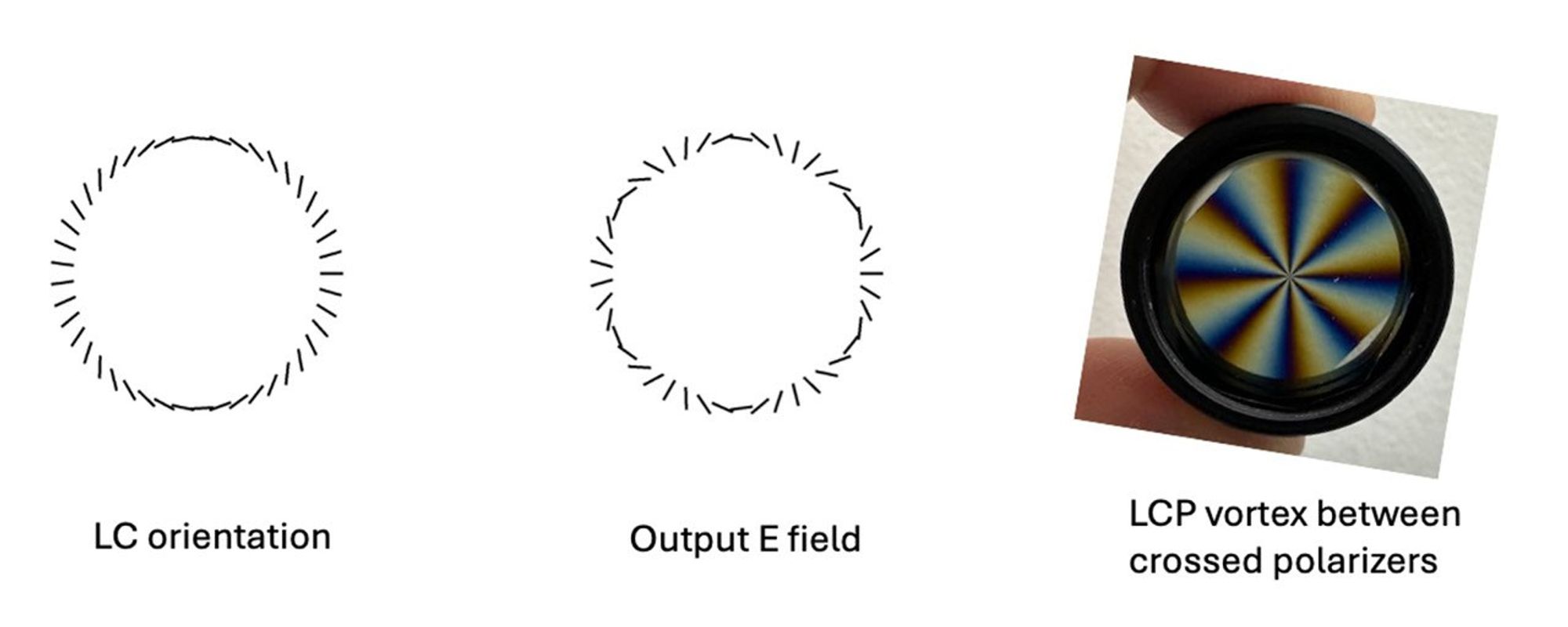
Orientation pattern of the liquid crystal polymer (LCP) molecules in an optical vortex layer. Center: The output electric (E) field directions such a mask produces. Right, an LCP vortex mask seen through crossed polarizers. Note that the mask is dark at all angles at which the output light is horizontally polarized (horizontal lines in the center panel), verifying its functionality.
Gene Serabyn, NASA JPL

At the same time, the team is also looking into alternative mask approaches with different advantages and disadvantages. In particular, they have been revisiting the idea of shaping the surface of a piece of glass to look like a helical turn of a screw. However, this design will only work across multiple wavelengths if one combines several different pieces of glass, each with its own screw height, and if further deformations of the surface shape are also implemented. Moreover, since only a rather small number of materials seem to have the characteristics required for this design, it is not yet clear what ultimate performance can be achieved by this technique. As a result, the team is also looking into fabricating their own artificial materials (i.e., metamaterials) for use in such masks. Metamaterials are thin layers of tiny nanoposts (see figure below) in which the nanopost heights, widths, shapes, and spacings can be selected to generate material properties that do not exist in nature. While this approach is very new, it is conceivable that it could be used to tailor materials that have the characteristics needed to make optical vortex masks work over a wide range of wavelengths.    
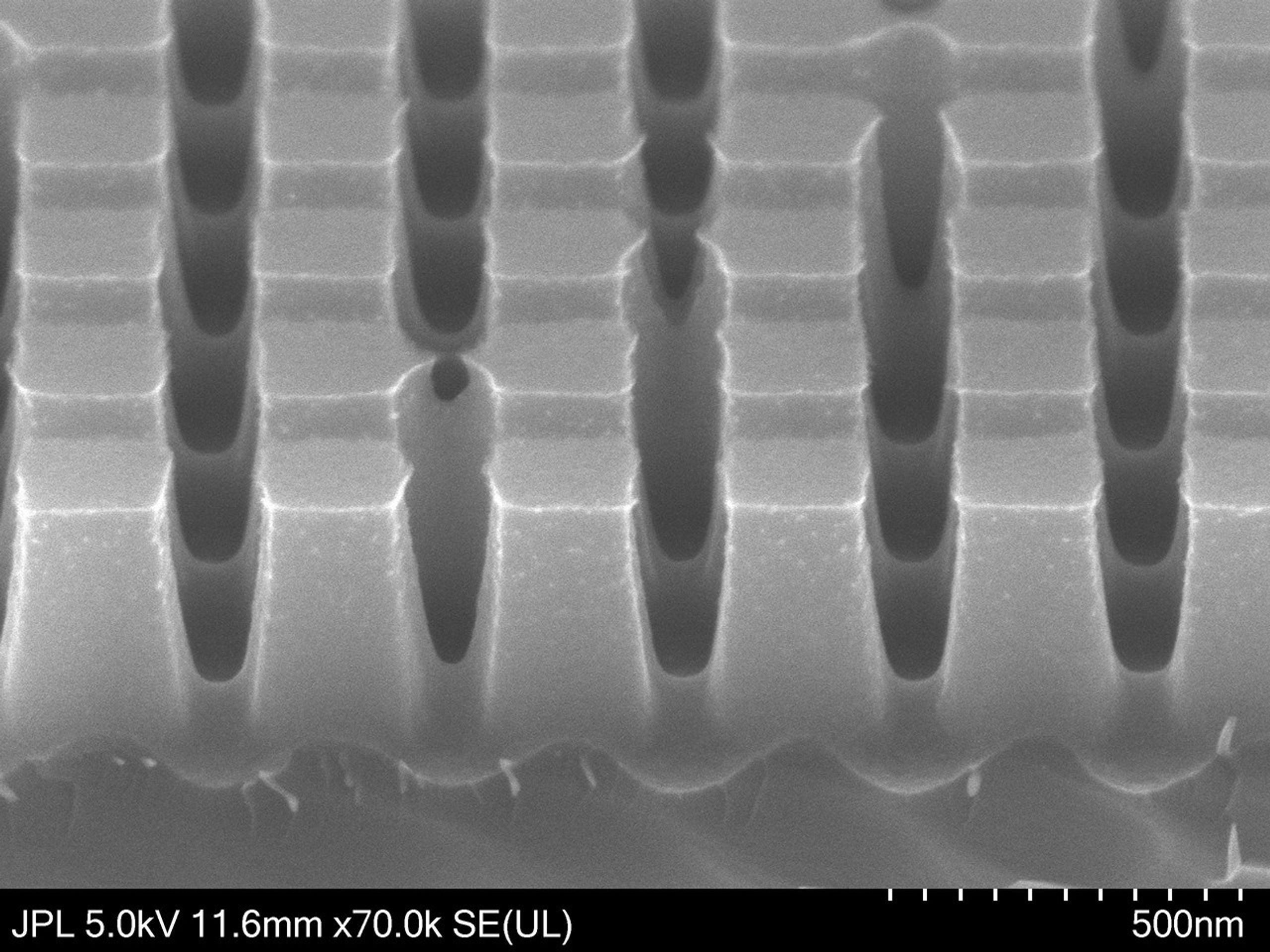
Electron microscope image of nanoposts.
Lorenzo König, NASA JPL

Optical vortex coronagraphs are becoming increasingly popular in the hunt for larger (brighter) exoplanets using ground-based telescopes, but seeing dimmer Earth-like exoplanets with a space-based telescope such as HWO will require vortex masks with vastly improved starlight rejection capabilities. While the liquid crystal polymer approach is the clear frontrunner, such masks also have limitations, so it is good that other possibilities are being investigated. These candidate technologies will be fully vetted and tested over the next few years to enable the fabrication of the optical vortex masks needed to be able to pick out and characterize nearby Earth-like exoplanets with HWO. 

For additional details, see the entry for this project on NASA TechPort. 

Project Lead(s): Eugene Serabyn, NASA Jet Propulsion Laboratory, California Institute of Technology, and Dimitri Mawet, California Institute of Technology 

Sponsoring Organization(s): NASA Astrophysics Division Strategic Astrophysics Technology (SAT) and Astrophysics Research and Analysis (APRA) programs. 

Part of this research was carried out at the Jet Propulsion Laboratory, California Institute of Technology, under contract with NASA (80NM0018D0004) 

<div class="usa-footer__primary-section bg-carbon-black-important">

	<div class="grid-container grid-container-widescreen padding-x-0">
		<img fetchpriority="low" width="63.99" height="53.94" class="width-8 margin-bottom-2" alt="NASA Logo" src="https://science.nasa.gov/wp-content/themes/nasa-child/assets/images/nasa-logo@2x.png" srcset="https://science.nasa.gov/wp-content/themes/nasa-child/assets/images/nasa-logo.svg">
	</div>

	<div class="grid-container grid-container-widescreen">
		<div class="grid-row">

			<div class="grid-col-12 tablet:grid-col-6 desktop:grid-col-4 margin-bottom-5 padding-right-0 tablet:padding-right-2 margin-bottom-5 desktop:margin-bottom-0  color-spacesuit-white">
				<div class="hds-footer-details">
					<h3 class="heading-22 line-height-md">National Aeronautics and Space Administration</h3>
					<p class="p-sm color-carbon-30">NASA explores the unknown in air and space, innovates for the benefit of humanity, and inspires the world through discovery.</p>

					<ul class="hds-footer-menu usa-unstyled-list">
						<li><a href="https://www.nasa.gov/about/"><span>About NASA&#039;s Mission</span></a></li>
					</ul>
					<a href="https://www.nasa.gov/get-involved/" target="_self" class="button-primary button-primary-sm link-external-false" tabindex="0">
						<span class="line-height-alt-1 color-spacesuit-white-important">Join Us</span>
						<svg viewBox="0 0 32 32" fill="none" xmlns="https://www.w3.org/2000/svg"><circle class="button-primary-circle" cx="16" cy="16" r="16"></circle><path d="M8 16.956h12.604l-3.844 4.106 1.252 1.338L24 16l-5.988-6.4-1.252 1.338 3.844 4.106H8v1.912z" class="color-spacesuit-white"></path></svg>
					</a>
				</div>
			</div>

			<div class="grid-col-12 tablet:grid-col-6 desktop:grid-col-6 margin-bottom-5 desktop:margin-bottom-0 padding-0">
				<div class="desktop:padding-left-5 desktop:padding-right-5 grid-row color-spacesuit-white">
					<div class="grid-col">
						<ul class="hds-footer-menu hds-menu-col-3 usa-unstyled-list">
							<li><a href="https://www.nasa.gov"><span>Home</span></a></li>
							<li><a href="https://www.nasa.gov/news/"><span>News &amp; Events</span></a></li>
							<li><a href="https://www.nasa.gov/multimedia/"><span>Multimedia</span></a></li>
							<li><a href="https://plus.nasa.gov/" class="usa-nav__link-nasa-live"><span>NASA+</span></a></li>
							<li><a href="https://www.nasa.gov/nasa-missions/"><span>Missions</span></a></li>
							<li><a href="https://www.nasa.gov/humans-in-space/"><span>Humans in Space</span></a></li>
							<li><a href="https://science.nasa.gov/earth/"><span>Earth</span></a></li>
							<li><a href="https://science.nasa.gov/solar-system/"><span>The Solar System</span></a></li>
							<li><a href="https://science.nasa.gov/universe/"><span>The Universe</span></a></li>
							<li><a href="https://science.nasa.gov/"><span>Science</span></a></li>
							<li><a href="https://www.nasa.gov/aeronautics/"><span>Aeronautics</span></a></li>
							<li><a href="https://www.nasa.gov/technology/"><span>Technology</span></a></li>
							<li><a href="https://www.nasa.gov/learning-resources/"><span>Learning Resources</span></a></li>
							<li><a href="https://www.nasa.gov/about/"><span>About NASA</span></a></li>
							<li><a href="https://www.nasa.gov/es/" target="_blank" rel="noopener"><span>NASA en Español</span></a></li>
						</ul>
					</div>
				</div>
			</div>

			<div class="grid-col-12 tablet:grid-col-4 desktop:grid-col-2 color-spacesuit-white  margin-bottom-5 tablet:margin-bottom-0 padding-right-5 desktop:padding-right-0">
				<div class="width-fit-content margin-left-0 desktop:margin-left-auto">
					<div class="hds-footer-socials margin-bottom-2">
						<h3 class="heading-16 color-carbon-40 margin-bottom-2">Follow NASA</h3>
						<ul class="social-icons margin-bottom-3">
							<li>
								<a href="https://www.facebook.com/NASA" title="NASA on Facebook" target="_blank" rel="noopener" aria-label="NASA on Facebook"><svg alt="Facebook" aria-hidden="true" focusable="false" width="9" height="18" viewBox="0 0 9 18" fill="none" xmlns="https://www.w3.org/2000/svg"><path d="M8.55557 4.25966H6.95557C6.31794 4.25966 6.1852 4.52158 6.1852 5.18173V6.63003H8.55557L8.30787 9.0004H6.1852V17.2967H2.62965V9.0004H0.259277V6.63003H2.62965V3.89462C2.62965 1.79803 3.73306 0.704102 6.21957 0.704102H8.55557V4.25966Z" fill="#F7F5F4"></path></svg></a>
							</li>
							<li>
								<a href="https://www.instagram.com/nasa/" title="NASA on Instagram" target="_blank"><svg alt="Instagram" aria-hidden="true" focusable="false" width="18" height="18" viewBox="0 0 18 18" fill="none" xmlns="https://www.w3.org/2000/svg"><path fill-rule="evenodd" clip-rule="evenodd" d="M4.74015 9.0004C4.74015 11.3542 6.64829 13.2611 9.00089 13.2611C11.3535 13.2611 13.2616 11.353 13.2616 9.0004C13.2616 6.6478 11.3535 4.74084 9.00089 4.74084C6.64829 4.74084 4.74015 6.6478 4.74015 9.0004ZM11.7625 9.00037C11.7625 10.5281 10.524 11.7654 8.9975 11.7654C7.47098 11.7654 6.23247 10.5281 6.23247 9.00037C6.23247 7.47267 7.47098 6.23533 8.9975 6.23533C10.524 6.23533 11.7625 7.47267 11.7625 9.00037Z" fill="#F7F5F4"></path><path d="M12.4344 4.57255C12.4344 5.12247 12.88 5.5681 13.4299 5.5681C13.9798 5.5681 14.4255 5.12129 14.4255 4.57255C14.4255 4.02262 13.9798 3.57699 13.4299 3.57699C12.88 3.57699 12.4344 4.02262 12.4344 4.57255Z" fill="#F7F5F4"></path><path fill-rule="evenodd" clip-rule="evenodd" d="M12.4225 17.2469C15.4317 17.1083 17.1111 15.4371 17.2474 12.4208C17.2877 11.5367 17.2972 11.2534 17.2972 9.0004C17.2972 6.74736 17.2877 6.46529 17.2474 5.57995C17.1123 2.57077 15.4388 0.893731 12.4225 0.755065C11.5372 0.713583 11.2539 0.704102 9.00089 0.704102C6.74785 0.704102 6.46578 0.713583 5.58044 0.755065C2.56652 0.892546 0.893034 2.56484 0.754367 5.57995C0.714071 6.46529 0.70459 6.74736 0.70459 9.0004C0.70459 11.2534 0.714071 11.5367 0.754367 12.4208C0.893034 15.4348 2.56533 17.1083 5.58044 17.2469C6.46578 17.2872 6.74785 17.2967 9.00089 17.2967C11.2539 17.2967 11.5372 17.2872 12.4225 17.2469ZM9.00089 2.19981C11.216 2.19981 11.4791 2.20692 12.3538 2.24721C14.6021 2.35032 15.651 3.41699 15.7553 5.64869C15.7944 6.52336 15.8027 6.78529 15.8027 9.0004C15.8027 11.2155 15.7944 11.4786 15.7553 12.3533C15.651 14.5838 14.6044 15.6528 12.3538 15.7548C11.4791 15.7951 11.2172 15.8034 9.00089 15.8034C6.78577 15.8034 6.52266 15.7939 5.64918 15.7548C3.39378 15.6517 2.35081 14.5803 2.2477 12.3533C2.20859 11.4774 2.19911 11.2155 2.19911 9.0004C2.19911 6.78529 2.20859 6.52336 2.2477 5.64869C2.35081 3.41581 3.39852 2.35032 5.64918 2.24721C6.52385 2.2081 6.78577 2.19981 9.00089 2.19981Z" fill="#F7F5F4"></path></svg></a>
							</li>
							<li>
								<a href="https://x.com/NASA" title="NASA on X" target="_blank"><svg alt="X" aria-hidden="true" focusable="false" width="1200" height="1227" viewBox="0 0 1200 1227" fill="none" xmlns="http://www.w3.org/2000/svg"><path d="M714.163 519.284L1160.89 0H1055.03L667.137 450.887L357.328 0H0L468.492 681.821L0 1226.37H105.866L515.491 750.218L842.672 1226.37H1200L714.137 519.284H714.163ZM569.165 687.828L521.697 619.934L144.011 79.6944H306.615L611.412 515.685L658.88 583.579L1055.08 1150.3H892.476L569.165 687.854V687.828Z" fill="white"/></svg></a>
							</li>
							<li>
								<a href="https://www.youtube.com/@NASA" title="NASA on YouTube" target="_blank"><svg alt="YouTube" aria-hidden="true" focusable="false" width="18" height="12" viewBox="0 0 18 12" fill="none" xmlns="https://www.w3.org/2000/svg"><path fill-rule="evenodd" clip-rule="evenodd" d="M3.73629 11.7981C6.224 11.9687 11.773 11.9687 14.2643 11.7981C16.9594 11.6132 17.2759 10.3012 17.2972 6.00015C17.2759 1.7074 16.963 0.387108 14.2643 0.202219C11.7742 0.0315521 6.224 0.0315521 3.73629 0.202219C1.04237 0.387108 0.724738 1.69911 0.70459 6.00015C0.724738 10.2929 1.03881 11.6132 3.73629 11.7981ZM6.6283 3.22455L12.4559 5.99552L6.6283 8.77596V3.22455Z" fill="#F7F5F4"></path></svg></a>
							</li>
						</ul>
					</div>

					<ul class="hds-footer-menu usa-unstyled-list">
                        <li><a href="https://www.nasa.gov/social-media/"><span>More NASA Social Accounts</span></a></li>
                        <li><a href="https://www.nasa.gov/nasa-newsletters/"><span>NASA Newsletters</span></a></li>
					</ul>
				</div>
			</div>

			<div class="grid-col-12 tablet:grid-col-8 desktop:grid-col-12 margin-bottom-2 padding-top-3 border-top-1px hds-footer-secondary">
				<ul class="color-carbon-30-important hds-footer-menu hds-footer-menu-horizontal usa-unstyled-list">
					<li><a href="https://www.nasa.gov/sitemap/"><span>Sitemap</span></a></li>
					<li><a href="https://www.nasa.gov/news/nasa-media-contacts/"><span>For Media</span></a></li>
					<li><a href="https://www.nasa.gov/nasa-web-privacy-policy-and-important-notices/"><span>Privacy Policy</span></a></li>
					<li><a href="https://www.nasa.gov/foia/"><span>FOIA</span></a></li>
					<li><a href="https://www.nasa.gov/no-fear-act/"><span>No FEAR Act</span></a></li>
					<li><a href="http://oig.nasa.gov/" target="_blank"><span>Office of the IG</a></li>
					<li><a href="https://www.nasa.gov/budgets-plans-and-reports/"><span>Budget &amp; Annual Reports</span></a></li>
					<li><a href="https://www.nasa.gov/organizations/budget-annual-reports/agency-financial-reports/"><span>Agency Financial Reports</span></a></li>
					<li><a href="https://www.nasa.gov/contact-nasa/"><span>Contact NASA</span></a></li>
					<li><a href="https://www.nasa.gov/accessibility/"><span>Accessibility</span></a></li>
				</ul>
			</div>

			<div class="margin-top-4 desktop:margin-top-0 grid-col-12">
				<ul class="color-carbon-40-important hds-footer-menu hds-footer-menu-horizontal hds-menu-meta usa-unstyled-list">
												<li class="hds-footer-meta">
							<div class="hds-footer-meta-label">
								Page Last Updated:								</div>
							<div class="hds-footer-meta-value">
							Mar 24, 2026								</div>
						</li>
						<li class="hds-footer-meta">
							<div class="hds-footer-meta-label">
								Page Editor:								</div>
							<div class="hds-footer-meta-value">
								Julie Stoltz								</div>
						</li>
											<li class="hds-footer-meta">
						<div class="hds-footer-meta-label">
							Responsible NASA Official for Science:							</div>
						<div class="hds-footer-meta-value">
							Diana Logreira							</div>
					</li>
				</ul>

			</div>

		</div>
	</div>

</div>

Related Posts